



If you’ve been in the network societies industry for more than a week, you’ve joined many Telegram groups. We’re in them too.
Here’s what happens in those groups every single day: someone asks “has anyone actually been to Project X?” Someone else shares a hot take on a new charter city announcement. A founder defends their governance model. A visitor posts photos and says “it’s not what the website shows.” Hundreds of conversations, scattered across dozens of chats, full of real insight, and then they scroll away forever.
What if we could actually capture that? The collective knowledge of a community that’s actually paying attention shouldn’t just evaporate into chat history.
For that we are using Bonfires.ai, a Web3 platform that turns unstructured data into knowledge graphs. You feed it conversations, links, documents, messy human stuff, and its AI organizes it into structured, queryable knowledge. It maps entities, relationships, and sentiment.
NS Nodes is a reference platform for the network societies ecosystem. Charter cities, popup cities, network states, SEZs, nomad communities: we catalogue them, categorize them, and try to make sense of what’s real and what’s vapor. Think of it as the directory for people who are serious about this space.
But a directory only captures what projects say about themselves. It doesn’t capture what the community thinks. Yet.
We’ve set up a Bonfire on the nsnodes Telegram group. The bot reads the conversation (everyone knows it’s there) and feeds it into Bonfires.ai. Over time, this builds a knowledge graph of how the community actually perceives the projects in the ecosystem: which ones have momentum, which ones raise red flags, which founders keep showing up and delivering.
The goal is to extract this into visual metrics on nsnodes.com: a radar graph per project showing community sentiment, perceived innovation, risk signals, and more. Not a rating system. A living intelligence layer, powered by the people who know the space best.
Why Subjective Data Matters to Community Experiments
Network societies aren’t startups. You can’t evaluate them with a pitch deck and a cap table. The things that matter — Does the community actually function? Would you move your family there? Is the governance real or theater? — are subjective by nature.
And that’s the point. Traditional due diligence doesn’t work when the thing you’re evaluating is a social experiment. The difference between a real community and a landing page is invisible from the outside. The only people who know are the people who’ve been there, talked to the founders, or watched the project evolve over months.
That knowledge exists. It’s just trapped in Telegram chats.
How would you organize and measure this information? Here’s our first version.
1. Belonging & Community
The “We” Factor
What it measures: Emotional cohesion, mutual recognition, and sense of family among members. Not just “are people nice?” but “do they identify as us?”
Extractable signals: Pronoun density (”we/us/our”), warmth markers (”love,” “family,” “aligned”), mutual support expressions, inside jokes, emoji sentiment (❤️ 🔥 👍), welcome rituals for newcomers.
Why it matters: Predicts retention better than any other metric. Networks with high belonging survive conflicts; those without it fragment when growth slows.
2. Autonomy & Agency
The “I” Factor
What it measures: Perceived ability to self-direct, influence collective decisions, and exit without penalty. Freedom within the system, not just from external systems.
Extractable signals: Self-direction language (”my voice,” “I chose”), decentralization praise vs. complaints about “waiting for approval,” exit narratives (”voting with feet”), governance participation confidence.
Why it matters: Distinguishes true network societies from cults or corporations. High autonomy + high belonging = sustainable decentralization.
3. Economic Opportunity
The “Fairness” Factor
What it measures: Perceived access to sustainable livelihood, fair compensation, and wealth-building potential—not just “can I make money?” but “is the game rigged?”
Extractable signals: Compensation satisfaction (”fair share,” “dignity”), opportunity narratives vs. exploitation complaints, wealth gap concerns, financial sustainability confidence, “giving back” language.
Why it matters: Economic anxiety destroys community faster than any other stressor. This metric predicts “mission drift” when idealists burn out.
4. Purpose Alignment
The “Why” Factor
What it measures: Clarity and resonance of collective mission. Do members share the same vision of what they’re building and why?
Extractable signals: Mission-driven language (”change the world,” “impact”), values alignment expressions, motivation beyond money, “meaningful work” narratives, concern about “mission drift.”
Why it matters: Replaces “attractiveness” (which is volatile and superficial). Purpose-aligned members stay through hardship; transactionally-motivated members leave at first better offer.
5. Scalability Tension
The “Growth Pain” Factor
What it measures: Felt experience of scale—coordination overhead, intimacy dilution, “vibe” preservation struggles. Not technical capacity, but psychological impact of growth.
Extractable signals: Growth pain language (”getting too big,” “lost the vibe”), coordination complaints, dilution concerns, nostalgia for “early days,” expansion vs. intimacy trade-off discussions.
Why it matters: Every network society faces this. The question isn’t whether tension exists, but whether members feel equipped to navigate it together.
6. Quality of Life
The “Sustainability” Factor
What it measures: Collective and individual wellbeing—burnout prevention, work-life balance, mental health, long-term viability. Not luxury, but sustainability.
Extractable signals: Burnout references, “need a break” language, sustainability pace discussions, stress markers, “24/7” complaints, peace-of-mind expressions, stepping-back narratives.
Why it matters: The “canary in the coal mine” metric. Quality of life degradation predicts collapse before financial or governance metrics show distress.
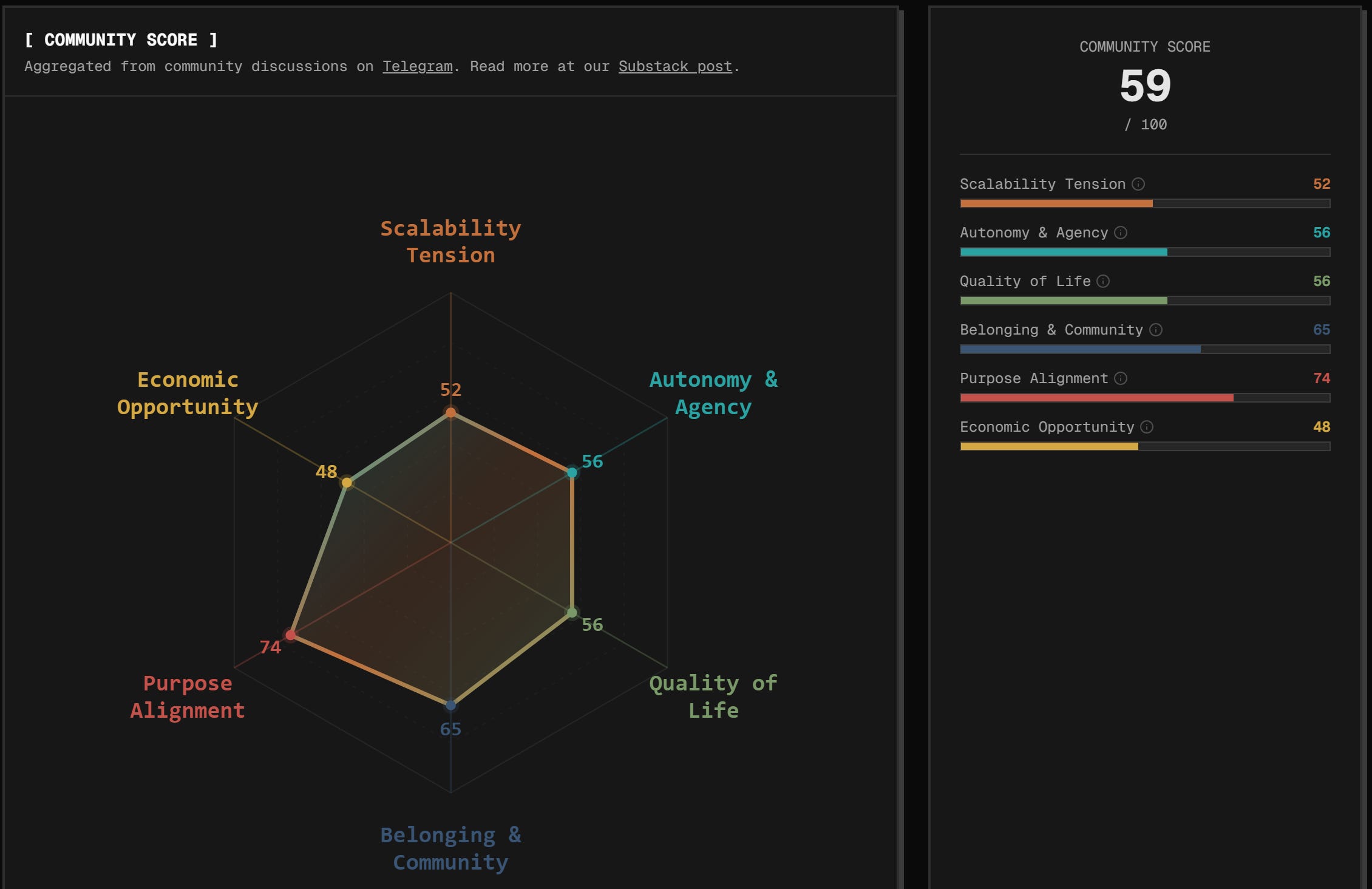
This is an experiment, and we want to be upfront about it.
It’s opt-in. If you join the nsnodes Telegram, you’ll see a clear notice that a Bonfire bot is active. If you’re not comfortable having your messages processed by AI, don’t post or leave. No hard feelings.
We know it’s early. We don’t have all the answers on what metrics will emerge, how accurate the sentiment mapping will be, or whether this scales. We’re testing it in the open because that’s how we build.
And yes, the data is subjective. That’s not a flaw: it’s the feature. Objective data tells you a project raised $100M. Subjective data tells you the community thinks the founders have already checked out. Both matter. Only one is hard to find.
AI is only getting started.
The bonfire is a tool. What we’re really building is a community that takes network societies seriously enough to evaluate them honestly, not just hype them or dismiss them.
If you care about charter cities, popup villages, network states, or any of the hundred experiments trying to build new ways of living together, we’d like you in the conversation. Come share what you know. Disagree with each other. Tell us which projects impressed you and which ones let you down. The AI will structure it. But the intelligence comes from you.